STUDY COMMITMENT6–8 hours / week24–30 hours in total
YOUR ACHIEVEMENTCommunity certificateOn successful completion
THE BIG PICTURE
Make intent precise. Make delivery verifiable.
When an AI agent writes the implementation, someone still has to define what “correct” means. Practice the discipline of specifying behavior, constraints, non-goals, and evidence before delegating the work.
What you will be able to do
↗Separate a problem statement from a preferred solution.
↗Specify observable behavior, constraints, and explicit non-goals.
↗Capture edge cases, failure states, and data contracts.
↗Divide a specification into bounded agent tasks.
↗Trace each important requirement to verification evidence.
↗Manage specification changes without losing architectural intent.
Who this is for
Developers who already use AI coding tools and want more control.
Technical leads responsible for architectural decisions and quality.
Product-minded engineers translating intent into implementation.
Before you begin
Experience building or reviewing a small software application.
Familiarity with Git, APIs, and basic testing concepts.
Access to a coding assistant; no specific vendor is required.
THE METHOD, EXPLAINED
What is spec-driven development?
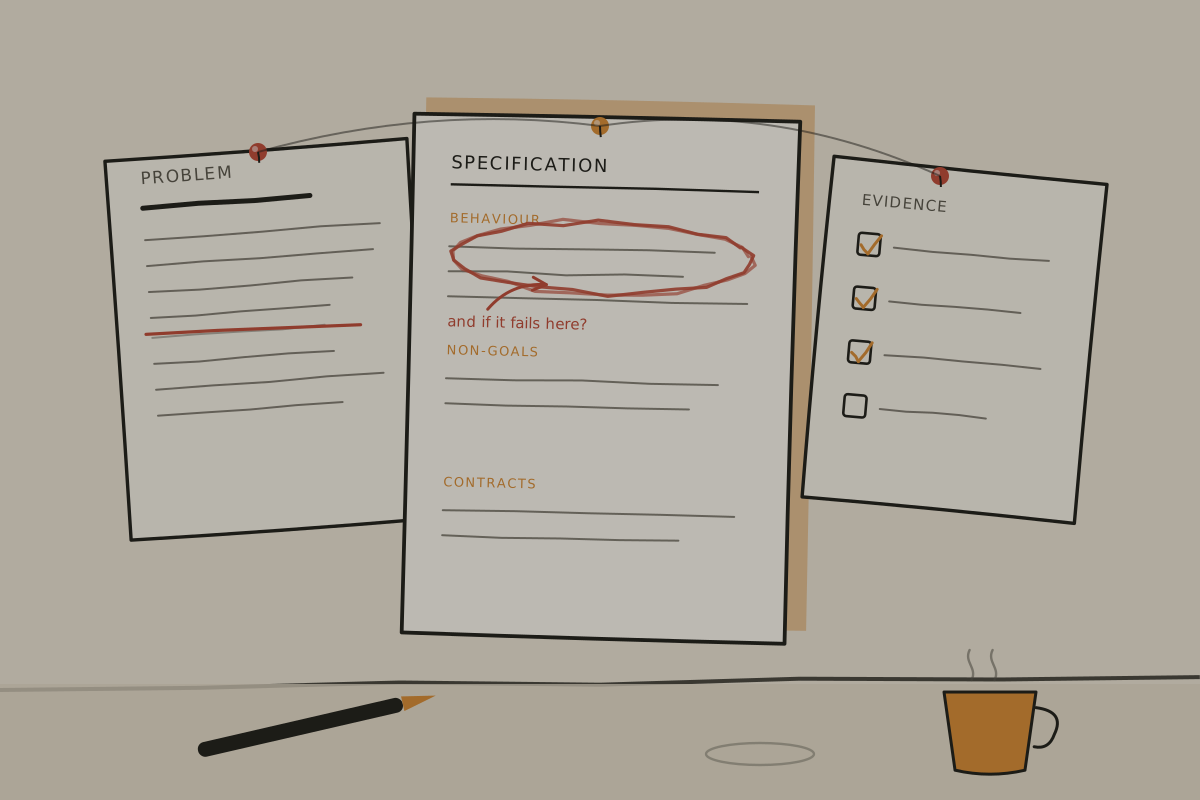
Spec-driven development is a way of building software in which a written specification — not a prompt, a ticket, or a conversation — is the primary artefact that work is produced from and judged against.
You write down the behaviour the system must exhibit, the constraints it must respect, the things it must deliberately not do, and the evidence that will prove each of those claims. Only then is the implementation produced — increasingly by an AI coding agent rather than by hand. The specification is what the agent reads, what the reviewer reviews, and what the tests are traced back to.
The shift matters because generation is no longer the bottleneck. A capable model can produce a plausible implementation of almost anything in minutes. What it cannot do is decide what “correct” means for your organisation, your users, your regulator, or your existing architecture. That decision stays with a human, and a specification is how that decision is recorded in a form an agent can act on and a team can argue with.
Spec-driven development is therefore less a new technology than a relocation of effort. The hours you no longer spend typing implementation move upstream into problem definition and downstream into verification. Teams that skip that relocation experience AI-assisted development as an acceleration of rework: code arrives faster, and so do the defects, the architectural drift, and the review fatigue.
The spec-driven loop. Each arrow is a checkpoint where a human can stop, correct, or accept.
The principles this course is built on
01
Intent before implementation
Describe the observable behaviour you need before anyone — human or agent — proposes how to build it. A solution written down too early quietly becomes the requirement.
02
Specify the negative space
Non-goals, forbidden states and out-of-scope behaviours carry as much information as the happy path. Most agent failures are enthusiasm, not incompetence.
03
Every requirement carries its evidence
A requirement with no defined way to verify it is a wish. Each statement in the spec names the test, check or demonstration that settles it.
04
Delegate in bounded slices
Agents perform far better against a task with explicit boundaries, permitted actions and a definition of done than against a broad instruction to “build the feature”.
05
Keep the spec alive
Reality argues back. When implementation reveals a better answer, the specification is amended and versioned — it does not silently fall out of date while the code moves on.
06
Humans own the “what” and the “why”
Problem framing, architectural trade-offs, risk appetite and acceptance are human responsibilities. The “how” is increasingly delegable; the judgment is not.
When it pays off — and when it does not
✓ Worth the effort when
The work touches money, personal data, permissions, or anything with a regulator attached.
More than one person — or more than one agent — has to arrive at a consistent answer.
The system already exists and a wrong change is expensive to unwind.
You expect the same feature to be re-implemented, ported, or audited later.
The requirement is genuinely ambiguous and the ambiguity is the real work.
× Probably not when
A throwaway prototype whose only purpose is to make a decision cheaper.
An exploratory spike where you do not yet know what question you are asking.
A change so small and so reversible that the spec would exceed the diff.
A domain you understand so well that the acceptance criteria are already unambiguous in one sentence.
Objections worth taking seriously
“It is just waterfall with extra steps.”
Waterfall fixes the whole system up front and resists change. A spec in this method is written per bounded slice, is expected to be amended, and is versioned precisely so that change is visible rather than silent.
“The specification has to be exhaustive.”
It has to be decisive, not exhaustive. A good spec settles the questions an implementer would otherwise guess at, and explicitly marks the ones that are safe to leave to judgment.
“It slows the team down.”
It moves the cost. Most of the time saved by fast generation is lost again in review cycles, rework and defect triage. Specification cost is paid once; ambiguity is paid every time someone touches the code.
“The agent can write the spec too.”
An agent can draft one, and that is a reasonable use of it. But a draft it produced and then implements against is a closed loop with no independent statement of correctness in it. A human has to accept the spec for it to mean anything.
THE WIDER FAMILY
Every method is driven by something
The “-driven development” family is usually presented as a list of competing camps. It is more useful to read it as a single question asked repeatedly: which artefact is allowed to decide what gets built? Each method answers differently, and the answers compose more often than they compete.
Ten software delivery methods compared by what drives the work, the primary artefact, what each is strongest at, and what each costs.
Method
What drives the work
Primary artefact
Strongest at
Costs you
VIBEVibe coding (no method)
An informal prompt and whatever comes back
Working code, no written intent
Throwaway prototypes and personal tools
No definition of correct; silent architectural drift
TDDTest-Driven Development
A failing test written before the code
A unit test suite
Tight feedback, regression safety, design pressure on interfaces
Describes units well and product intent poorly
BDDBehaviour-Driven Development
A shared example of behaviour in business language
Given–When–Then scenarios
A common language across product, QA and engineering
Scenario suites rot quickly without ownership
ATDDAcceptance-Test-Driven Development
An acceptance criterion agreed before work starts
Automated acceptance tests
Customer-visible definition of done
Needs real discipline to stay automated and current
DDDDomain-Driven Design
The domain model and its ubiquitous language
Bounded contexts and a shared model
Complex domains, integration boundaries, long-lived systems
Heavy for small systems; easy to cargo-cult
MDDModel-Driven Development
A formal model that code is generated from
A UML or domain-specific-language model
Regulated, repetitive or multi-target generation
Tooling lock-in and painful round-tripping
CDDContract-First / API-First
An interface contract agreed before either side is built
An OpenAPI, protobuf or schema definition
Parallel work across teams; verifiable integration
Says nothing about behaviour behind the interface
TyDDType-Driven Development
The type system and its signatures
Types that make illegal states unrepresentable
Correctness by construction in expressive languages
Bounded by what your type system can actually say
DocDDDocumentation-Driven Development
The user-facing document written first
README, changelog or API documentation
Outside-in thinking; catching bad ergonomics early
Documentation drifts the moment attention moves on
SDDSpec-Driven Development
A written specification of behaviour, constraints and non-goals
The specification plus a requirement-to-evidence matrix
Directing AI agents; keeping human judgment on what and why
These are layers, not rivals. A mature spec-driven workflow typically states acceptance criteria in BDD-style examples, expresses interfaces as contracts, and verifies the result with tests that a TDD practitioner would recognise. What spec-driven development adds is the part the others predate: an artefact precise enough to hand to a non-human implementer, and a traceable answer to “how do we know it did what we asked?”
Where spec-driven development sits
Ahead of TDD, not instead of it. TDD starts once you know what the unit should do; the specification is where that knowledge is decided, argued over and recorded.
Above the contract. An API contract fixes the shape of an interface. The specification fixes what happens behind it, including what must never happen.
Beside the domain model. Domain-driven design gives you the language to write a precise specification in. The specification is where that language gets used to settle a concrete behaviour.
Against vibe coding — but only on work that will outlive the afternoon. The method earns its cost where correctness is contested, expensive or durable.
INSIDE THE COURSE
A curriculum with real depth.
7 modules · 24–30 hours · Learning objectives, key concepts and an applied exercise in every module
01Week 1 · ≈4 hoursBeyond vibe coding+
Explore why plausible code is not the same as a correct system, and where spec-driven development sits among the methods you already use.
By the end you can
Explain the intent gap and identify it in a real request.
Place spec-driven development relative to TDD, BDD, ATDD, DDD, contract-first and model-driven approaches.
Judge when a lightweight specification is sufficient and when it is not.
What “driven” means in each method, and why they compose rather than compete
What humans own: problem framing, architecture, and decisions
The economics: where the hour goes before and after assisted development
When lightweight specifications are enough — and when they are over-engineering
Key concepts introduced
Vibe coding
Generating code from an informal prompt and accepting it on the strength of how plausible it looks, with no written definition of correct.
Intent gap
The distance between what a stakeholder meant and what the request actually said. A model closes it by guessing, confidently.
Executable specification
A behaviour description precise enough that an agent can implement from it and a test suite can be derived from it without further guessing.
PUT IT INTO PRACTICE
Audit an ambiguous prompt and document its missing decisions.
YOU PRODUCE An audit listing every decision the prompt silently delegated, and who should have made each one.
02Week 1 · ≈4 hoursDefine the problem+
Write a brief that exposes assumptions before they become code.
By the end you can
Separate a problem statement from a preferred solution.
State non-goals with the same care as goals.
Convert open questions into either a decision or a recorded assumption.
What is covered
Users, jobs, observable outcomes, and success measures
Scope, non-goals, constraints, and dependencies
Solution smuggled in as requirement: how to spot it
Resolving open questions and recording assumptions
Sizing a slice so that a wrong answer stays cheap
Key concepts introduced
Non-goal
A behaviour deliberately excluded from scope, written down so neither a reviewer nor an agent quietly reintroduces it.
Observable outcome
A change in the world that someone outside the system could notice — the only kind of success worth specifying.
Slice
A bounded unit of specification and delivery, small enough that discarding it is not painful.
PUT IT INTO PRACTICE
Produce a problem brief with measurable success criteria.
YOU PRODUCE A problem brief with users, jobs, success measures, non-goals and a recorded assumptions list.
03Week 2 · ≈5 hoursSpecify behavior+
Describe what must happen, what must never happen, and how anyone will know.
By the end you can
Write acceptance criteria that two reasonable people cannot disagree about.
Specify failure behaviour as deliberately as the happy path.
Cover authorisation, privacy and accessibility as requirements rather than afterthoughts.
What is covered
Happy paths, edge cases, and failure states
Given–when–then examples and acceptance criteria
The binary-and-observable test for a criterion
Authorization boundaries, privacy, and accessibility
Splitting a compound requirement hiding in one sentence
Key concepts introduced
Acceptance criterion
A single, observable, binary statement about the system. If two reasonable people can disagree about whether it passed, it is not yet one.
Failure behaviour
What the system does when the happy path ends. It is behaviour, and it is specified, not discovered.
Compound requirement
Two obligations wearing one sentence. Splitting them is often the highest-value edit in a review.
PUT IT INTO PRACTICE
Write a behavior specification for a small registration flow.
YOU PRODUCE A behaviour specification with happy path, edge cases, failure states and binary acceptance criteria.
04Week 2 · ≈4 hoursContracts and architecture+
Define the interfaces that let independent pieces — and independent agents — fit together.
By the end you can
Express data models and validation rules as contracts an implementer cannot misread.
Specify state transitions, concurrency and idempotency explicitly.
Record architectural decisions with their trade-offs and rejected alternatives.
What is covered
Data models, API contracts, and validation rules
State transitions, concurrency, and idempotency
Uniqueness, ordering and time as specification problems
Architecture decision records and explicit trade-offs
Designing contracts that let two agents work in parallel
Key concepts introduced
Data contract
The agreed shape, constraints and invariants of the data crossing a boundary — the part an agent should never be left to invent.
State transition table
An exhaustive statement of which states may follow which, which turns “it should not happen” into “it cannot”.
Architecture decision record
A dated note of a decision, its alternatives and its trade-offs, so a later change is informed rather than accidental.
PUT IT INTO PRACTICE
Create a data contract and a state-transition table.
YOU PRODUCE A data contract, a complete state-transition table, and one architecture decision record.
05Week 3 · ≈5 hoursDelegate to an agent+
Translate the specification into work an agent can complete safely, and review its first attempt.
By the end you can
Assemble a task pack with context, constraints, permitted actions and a definition of done.
Place review checkpoints before anything irreversible.
Review an agent implementation against the specification rather than against intuition.
What is covered
Task boundaries and the definition of done
Providing context, constraints, and permitted actions
The pre-delegation checklist
Checkpoints, review gates, and escalation rules
Reading an agent implementation for what the spec did not say
Key concepts introduced
Task pack
The bounded unit of work handed to an agent: context, constraints, permitted actions, definition of done, and review checkpoints.
Definition of done
The evidence that ends the task. It names artefacts and checks, never effort.
Permitted actions
An explicit list of what may be created, changed or deleted, so over-reach is a violation rather than a surprise.
PUT IT INTO PRACTICE
Prepare an agent task pack and review its first implementation.
YOU PRODUCE A task pack, the resulting implementation, and a review noting every gap the specification left open.
06Week 3 · ≈4 hoursVerify against the specification+
Use evidence to decide whether a requirement has been met — and treat missing evidence as a finding.
By the end you can
Build a traceability matrix from requirements to concrete evidence.
Design positive, negative, boundary and regression cases for a requirement.
Detect implementation drift and incomplete evidence in review.
What is covered
Requirement-to-test traceability
Positive, negative, boundary, and regression cases
Tests derived from the requirement versus tests derived from the diff
Reviewing implementation drift and incomplete evidence
Reviewing a deliberately flawed patch against a specification
Key concepts introduced
Traceability matrix
A mapping from every critical requirement to the specific evidence that settles it. An empty cell is a blocking finding.
Boundary case
The test at the exact edge of a rule — the deadline instant, the limit value — where specifications most often turn out to be ambiguous.
Implementation drift
The gap that opens when code evolves and the specification does not.
PUT IT INTO PRACTICE
Build a traceability matrix and test a deliberately flawed patch.
YOU PRODUCE A complete traceability matrix plus a review of the flawed patch identifying each unmet requirement.
07Week 4 · ≈4 hoursChange without losing intent+
Keep the specification useful after the first implementation — the part that separates this from waterfall.
By the end you can
Handle a change request with impact analysis and a versioned decision.
Keep specification, tests and code aligned as all three move.
Run a repeatable delivery and review protocol with a team.
What is covered
Change requests, versioned decisions, and impact analysis
Keeping code, tests, and specification aligned
Deprecating a requirement without erasing its history
Specification review as a team practice
A repeatable delivery and review protocol
Key concepts introduced
Change request
An amendment to the specification with its impact analysis attached, which makes change visible rather than silent.
Specification version
A dated, reviewable state of the spec, so “what did we agree?” has an answer.
Alignment debt
The accumulated distance between what the spec says, what the tests check, and what the code does.
PUT IT INTO PRACTICE
Complete the capstone and a review explaining one specification change.
YOU PRODUCE Capstone specification, implementation, verification matrix, and a versioned change record.
The vocabulary you will be using
Executable specification
A behaviour description precise enough that an agent can implement from it and a test suite can be derived from it without further guessing.
Non-goal
A behaviour deliberately excluded from scope, written down so that neither a reviewer nor an agent quietly reintroduces it.
Acceptance criterion
A single, observable, binary statement about the system. If two reasonable people can disagree on whether it passed, it is not yet one.
Traceability matrix
A mapping from every critical requirement to the specific evidence — test, check, or demonstration — that settles it.
Task pack
The bounded unit of work handed to an agent: context, constraints, permitted actions, definition of done, and review checkpoints.
Implementation drift
The gap that opens when code evolves and the specification does not. Detected by traceability, prevented by versioned change requests.
SEE IT BEFORE YOU BUY IT
A real session, start to finish.
A representative lecture from the first half of the course. It takes a one-line feature request, shows what a coding agent actually does with it, and rebuilds it as a specification with acceptance criteria and traceable evidence.
The sample is genuine teaching material from this course, condensed for the web. Full sessions include live walkthroughs, the handout, and the exercise review.
LEARNING THROUGH DOING
Make the work your own.
Three applied assignments build toward a capstone. Each asks you to explain your decisions and show the evidence behind your result.
01
Problem & behavior brief
Scope, non-goals, user scenarios, and measurable acceptance criteria.
02
Agent implementation pack
Contracts, task boundaries, permitted actions, and review checkpoints.
03
Verification matrix
A mapping from every critical requirement to concrete test evidence.
THE CAPSTONE PROJECT
Specify and direct a registration service
Start with an ambiguous course-registration request. Define its behavior, data contracts, duplicate-payment handling, and failure states. Direct an AI agent to implement a bounded slice, then prove the result against your specification.
DEFINEBUILDVERIFYEXPLAIN
One final exam. Clear expectations.
A 75-minute scenario exam: repair an incomplete specification, identify conflicting constraints, review an agent task plan, and design verification evidence.
70%Minimum exam score3 + 1Assignments + capstone1Final exam per course
Certificate requirements: submit all three assignments, meet the capstone acceptance criteria, and score at least 70% in the final exam. Assessment focuses on correctness, reasoning, verification, and clear communication.
THE COURSE PERSPECTIVE
Meet Arman.
Arman Farhadi
Specification design & agent-directed delivery
Arman is the teaching persona for Spec-Driven Development. His course perspective connects clear problem definitions, small implementation steps, and evidence-based verification.
“Start with the behavior you need. Give the agent boundaries. Make the result prove itself.”
Fictional teaching persona · AI-generated portrait. This profile does not represent a real person's credentials or employment history.
RECOGNITION FOR YOUR WORK
A certificate. Backed by practice.
Successfully complete the course requirements to earn your AI Pioneers Community certificate.
A/ AI PioneersSAMPLE · NOT ISSUED
Community certificate of completion
Alex Morgan
has successfully completed the assignments and final assessment in
Spec-Driven Development
AI PioneersAI Pioneers Community
A/
October 2026Illustrative completion date
Illustrative sample with a fictional learner name. Your certificate is issued after assessment, not at registration. This is a community certificate of completion, not an accredited degree or professional license.
Take a useful toolkit with you
↳Specification template
↳Acceptance-criteria worksheet
↳Agent task-pack template
↳Requirement-to-test matrix
BEFORE YOU REGISTER
A few good questions.
When does the course start?
This course begins on 28 September 2026. Registration closes on 22 September 2026 at 21:59 UTC. Plan for 6–8 hours / week over 4 weeks.
Can I see the teaching material before registering?
Yes. The sample session is a condensed version of a real lecture from this course, including the diagrams used in class and the instructor's notes.
Is this the course classroom?
After confirmed payment, your welcome email provides account access. Your My learning dashboard contains the published lessons and resources. Assignment and examination arrangements are provided by your instructor.
Do I need a particular AI subscription?
The curriculum is organized around engineering practices rather than a single vendor. You need access to the tools listed in the prerequisites. Any third-party AI subscriptions or API usage are separate from the course fee.
How much of this is theory?
Every module ends with an applied exercise and a concrete deliverable. The concepts exist to make the practice repeatable, not the other way around. Roughly a third of your time is reading and discussion; the rest is building, reviewing and verifying.
How do I earn the certificate?
Submit the three assignments, complete the capstone against its acceptance criteria, and pass the final exam with a score of at least 70%. Simply purchasing the course does not earn a certificate.
What happens when payment is paused?
You can still explore the entire curriculum. Registration through checkout becomes available when the course administrator enables payment, provided the registration deadline has not passed.
 Course teaching personaArman Farhadi ↗