STUDY COMMITMENT6–8 hours / week18–24 hours in total
YOUR ACHIEVEMENTCommunity certificateOn successful completion
THE BIG PICTURE
Your next development skill is direction.
Generating code is the easy part. The valuable skill is knowing what context to supply, which approach to choose, and how to decide whether a change deserves to ship. Develop a repeatable workflow around a real repository.
What you will be able to do
↗Select models using task difficulty, cost, latency, and data constraints.
↗Build a concise context pack for an unfamiliar repository.
↗Turn a request into a small, reviewable implementation plan.
↗Use models to explore failures and improve test coverage.
↗Review generated code for security, maintainability, and correctness.
↗Build a personal workflow that includes explicit human checkpoints.
Who this is for
Software developers beginning to use AI in everyday work.
Experienced engineers looking for a more systematic workflow.
Technical leads who review AI-assisted changes.
Before you begin
Basic programming experience in any language.
Comfort reading code, using Git, and running tests.
An editor with an AI assistant or access to a chat model.
THE METHOD, EXPLAINED
What does AI-native development mean?
AI-native development is not using a model occasionally. It is redesigning your working method around one — deciding what context to supply, where to place human checkpoints, and what evidence a change must carry before it ships.
The first months of model-assisted work usually produce a speed-up in typing and no change in outcomes. The reason is that typing was never the constraint. Understanding an unfamiliar system, choosing an approach, and deciding whether a change is safe are the constraints, and none of them improve because completions arrive faster.
What does change outcomes is treating the model as a collaborator with a specific and consistent profile: fast, broad, confident, and structurally unable to know what it was not told. That profile implies a method. Supply context deliberately rather than hoping it infers your conventions. Ask for a plan before an implementation. Keep changes small enough to review honestly. Require evidence — a failing test that now passes, a reproduction that no longer reproduces — rather than reassurance.
The team-level version of the same idea is the one that decides whether this works: reviewers apply the same standard to generated code as to human code, the context that produces good results is written down and shared rather than re-discovered per developer, and the metric you watch is rework and review time, not lines produced.
The AI-assisted change cycle. The diamonds are the human checkpoints that make the speed safe.
The principles this course is built on
01
Context is the real input
Output quality tracks the quality of the context pack far more than the choice of model. Invariants, conventions and boundaries have to be stated.
02
Plan, then implement
Ask for an approach and its trade-offs before any code. A plan is cheap to reject; a 600-line patch is not.
03
Keep the diff reviewable
A change you cannot review honestly is a change you are accepting on faith. Small, independently reviewable steps beat one confident sweep.
04
Demand evidence, not confidence
A fix is a reproduction that stops reproducing. Fluent explanation is not verification.
05
Know what must never leave
Secrets, customer data and private code have boundaries. Decide them before the convenient paste, not after.
06
Measure rework, not output
Velocity that produces review backlog and defect churn is not velocity. Track review time and change-failure rate alongside throughput.
Where model assistance is strongest — and weakest
✓ Worth the effort when
Explaining unfamiliar code, dependencies and call paths.
Drafting tests, fixtures and boilerplate against a clear contract.
Generating candidate hypotheses for a bug you can reproduce.
Mechanical refactors, migrations and translations with a verifiable result.
Reviewing your own work for the things you stopped seeing.
× Probably not when
Decisions that depend on organisational context it has never been given.
Architecture with long-lived consequences and competing stakeholders.
Anything where a plausible-but-wrong answer is expensive and hard to detect.
Security-critical logic accepted without independent review.
Objections worth taking seriously
“It writes the boring parts, so review matters less.”
Boring code fails in boring, expensive ways. Generated code carries the same review obligation as any contribution — arguably more, since no one has held the whole of it in their head.
“A bigger model would fix this.”
Most disappointing results are context failures, not capability failures. Fix the context pack before changing the model.
“Tests it wrote prove it works.”
Tests written from the same misunderstanding as the implementation agree with it perfectly. Derive tests from the requirement, not from the diff.
“Measuring this is impossible.”
Review time, rework rate, change-failure rate and defect escape rate are all measurable, and all more honest than counting accepted suggestions.
INSIDE THE COURSE
A curriculum with real depth.
6 modules · 18–24 hours · Learning objectives, key concepts and an applied exercise in every module
01Week 1 · ≈4 hoursA model is a collaborator+
Understand the strengths and failure modes of model-assisted work, and calibrate trust accordingly.
By the end you can
Describe why a model produces fluent, confident, wrong output.
Choose between chat, inline completion and agent workflows for a given task.
Select a model on task fit, cost and data constraints rather than on rank.
What is covered
Probabilistic output, plausible errors, and context limits
The five shapes of plausible failure
Chat, inline completion, and coding-agent workflows
Choosing a model without chasing a leaderboard
Data boundaries: what must never leave your machine
Key concepts introduced
Plausible failure
Output that is fluent, well-structured, confidently explained, and wrong — the dominant risk of assisted development.
Workflow shape
Whether the model completes, converses or acts. Each shape has a different review obligation.
Data boundary
The line customer data, secrets and private code may not cross — decided before the convenient paste.
PUT IT INTO PRACTICE
Compare two model workflows on the same small programming task.
YOU PRODUCE A short comparison noting where each workflow helped, where it misled you, and what you would use next time.
02Week 1 · ≈4 hoursRead the repository first+
Help a model understand the system it is changing — deliberately, not by hoping it infers.
By the end you can
Assemble a context pack that fits on one screen.
Identify and state the invariants a change must not break.
Decide what must not be shared, before sharing anything.
What is covered
Architecture maps, dependency boundaries, and conventions
Selecting files and explaining what must stay true
Why volume is not context
Keeping the context pack in the repository, shared and current
Secrets, private code, and data-sharing boundaries
Key concepts introduced
Context pack
The curated set of files, conventions and invariants supplied before a model is asked to change anything.
Invariant
Something that must remain true after the change — stated explicitly, because it cannot be inferred from code alone.
Convention debt
Six competing patterns in one repository. A model will faithfully reproduce whichever one it was shown.
PUT IT INTO PRACTICE
Build a repository context pack and identify three invariants.
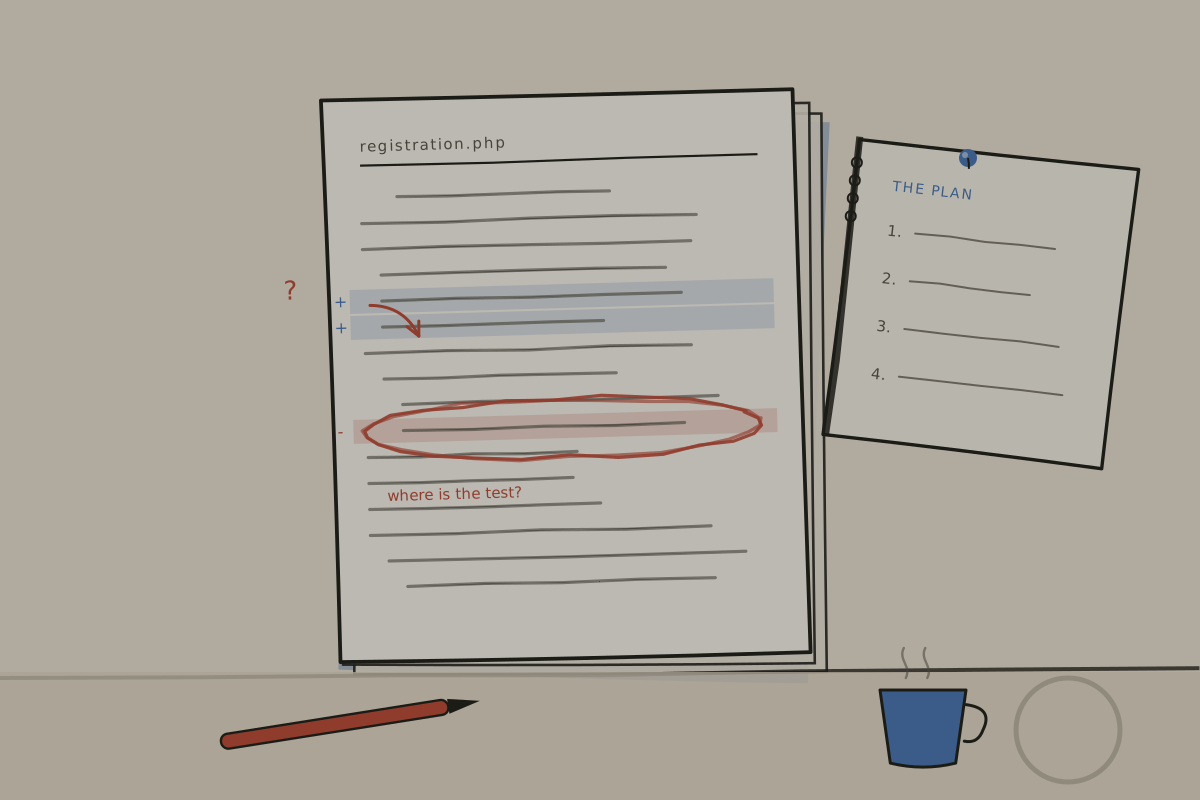
YOU PRODUCE A one-screen context.md committed to the repository, with invariants and out-of-scope areas stated.
03Week 2 · ≈3 hoursPlan a small change+
Make intent specific before asking for implementation — and reject a plan cheaply.
By the end you can
Turn an ambiguous request into scoped, independently reviewable steps.
Require an assumptions list and read it as a diagnostic on your own brief.
Reject a plan with a specific, actionable reason.
What is covered
Breaking work into independently reviewable steps
Acceptance criteria and useful examples
Requesting alternatives and the reasons they were dropped
Clarification, assumptions, and technical trade-offs
The cost asymmetry between rejecting a plan and rejecting a patch
Key concepts introduced
Change plan
The agreed approach and its trade-offs, reviewed before implementation begins and cheap to reject.
Assumption list
What the model had to decide because you did not say. The most useful output in the cycle.
Reviewable step
A change small enough that a reviewer can honestly hold all of it in their head at once.
PUT IT INTO PRACTICE
Turn an ambiguous feature request into a scoped change plan.
YOU PRODUCE A change plan with alternatives considered, assumptions surfaced, and one documented rejection.
04Week 2 · ≈4 hoursImplement and debug+
Run short iterations with explicit evidence rather than reassurance.
By the end you can
Reproduce a defect before proposing any fix.
Keep diffs small enough to review honestly.
Test competing hypotheses instead of accepting the first explanation.
What is covered
Patch review and controlling the size of changes
Reproducing bugs before proposing fixes
Interpreting logs and testing competing hypotheses
Recognising a fluent explanation produced without execution
Knowing when to discard the thread and restart
Key concepts introduced
Reproduction
The failing case that defines the bug. A fix is a reproduction that stops reproducing.
Hypothesis testing
Generating several candidate causes and disproving them, rather than adopting the first plausible story.
Context rot
The point at which a long thread carries more confusion than context, and restarting is cheaper than correcting.
PUT IT INTO PRACTICE
Fix a seeded bug with a regression test and an explanation.
YOU PRODUCE A verified fix, a regression test derived from the requirement, and a short debugging notebook.
05Week 3 · ≈4 hoursReview, test, and secure+
Apply the same standards you would to any contributor — and one or two more.
By the end you can
Review a generated change through six explicit lenses, in order.
Distinguish tests that verify the requirement from tests that echo the diff.
Identify the security and dependency risks assisted changes most often carry.
What is covered
Six review lenses: correctness, contract, security, tests, maintainability, blast radius
Unit, integration, and behavior-focused test selection
Input validation, authorization, and dependency risks
Avoiding tests that merely repeat the implementation
Reviewing what is absent as carefully as what is present
Key concepts introduced
Tautological test
A test derived from the implementation, so it agrees with the bug and proves nothing.
Blast radius
What breaks if this change is wrong, and how quickly it can be undone.
Silent contract break
A refactor that preserves every call site and quietly changes the meaning of one of them.
PUT IT INTO PRACTICE
Review an AI-generated change and document the defects you find.
YOU PRODUCE A review dossier covering all six lenses, with findings ranked by blast radius.
06Week 3 · ≈4 hoursShip with confidence+
Turn scattered good habits into a reusable development method your team can adopt.
By the end you can
Define where the human checkpoints sit and why each is defensible.
Record decisions so a reviewer can audit what was accepted and rejected.
Measure rework and review time, not output volume.
What is covered
Checkpoints for planning, implementation, and review
Decision logs and auditable acceptance
Release notes, rollback thinking, and evidence summaries
Measuring review time, rework and change-failure rate
Rolling a personal method out to a team without ceremony
Key concepts introduced
Decision log
A short record of what you accepted, what you rejected, and why — the artefact that makes a review defensible.
Rework rate
The proportion of shipped change that has to be revisited. The honest counterweight to throughput.
Ceremonial review
Approval given without scrutiny. Worse than no review, because it manufactures accountability.
PUT IT INTO PRACTICE
Deliver the capstone pull request and your personal AI workflow.
YOU PRODUCE Capstone pull request, decision log, and a one-page personal development playbook.
The vocabulary you will be using
Context pack
The curated set of files, conventions and invariants supplied to a model before it is asked to change anything.
Invariant
Something that must remain true after the change. Stated explicitly, because a model cannot infer what was never written down.
Change plan
The agreed approach and its trade-offs, reviewed before implementation begins and cheap to reject.
Decision log
A short record of what you accepted from the model, what you rejected, and why — the artefact that makes a review defensible.
Plausible failure
Output that is fluent, well-structured, confidently explained, and wrong. The dominant risk of assisted development.
Rework rate
The proportion of shipped change that has to be revisited. The honest counterweight to raw throughput.
SEE IT BEFORE YOU BUY IT
A real session, start to finish.
A representative lecture from the middle of the course. It replaces ad hoc prompting with a repeatable cycle: build the context pack, get a plan before an implementation, and require evidence rather than reassurance.
The sample is genuine teaching material from this course, condensed for the web. Full sessions include live walkthroughs, the handout, and the exercise review.
LEARNING THROUGH DOING
Make the work your own.
Three applied assignments build toward a capstone. Each asks you to explain your decisions and show the evidence behind your result.
01
Repository context pack
An architecture summary, conventions, and preserved invariants.
02
Debugging notebook
A reproducible bug, competing hypotheses, and a verified fix.
03
Review dossier
A structured review of correctness, tests, and security.
THE CAPSTONE PROJECT
Ship a small feature in an existing repository
Take a feature from request to review-ready patch. Submit a change plan, a focused implementation, relevant tests, and a decision log explaining what you accepted or rejected from the model.
DEFINEBUILDVERIFYEXPLAIN
One final exam. Clear expectations.
A 60-minute practical scenario exam: select a model workflow, improve a context pack, review a patch, and justify the tests needed before release.
70%Minimum exam score3 + 1Assignments + capstone1Final exam per course
Certificate requirements: submit all three assignments, meet the capstone acceptance criteria, and score at least 70% in the final exam. Assessment focuses on correctness, reasoning, verification, and clear communication.
THE COURSE PERSPECTIVE
Meet Noah.
Noah Reed
AI-assisted software development
Noah is the teaching persona for our AI-assisted development track. His course perspective focuses on working confidently in an existing codebase: understanding context, selecting tools, reviewing changes, and testing the result.
“Use a model to accelerate your thinking, then use engineering evidence to check the work.”
Fictional teaching persona · AI-generated portrait. This profile does not represent a real person's credentials or employment history.
RECOGNITION FOR YOUR WORK
A certificate. Backed by practice.
Successfully complete the course requirements to earn your AI Pioneers Community certificate.
A/ AI PioneersSAMPLE · NOT ISSUED
Community certificate of completion
Alex Morgan
has successfully completed the assignments and final assessment in
AI-Native Development
AI PioneersAI Pioneers Community
A/
November 2026Illustrative completion date
Illustrative sample with a fictional learner name. Your certificate is issued after assessment, not at registration. This is a community certificate of completion, not an accredited degree or professional license.
Take a useful toolkit with you
↳Repository context template
↳Model-selection worksheet
↳Code-review checklist
↳Personal development playbook
BEFORE YOU REGISTER
A few good questions.
When does the course start?
This course begins on 2 November 2026. Registration closes on 27 October 2026 at 23:59 UTC. Plan for 6–8 hours / week over 3 weeks.
Can I see the teaching material before registering?
Yes. The sample session is a condensed version of a real lecture from this course, including the diagrams used in class and the instructor's notes.
Is this the course classroom?
After confirmed payment, your welcome email provides account access. Your My learning dashboard contains the published lessons and resources. Assignment and examination arrangements are provided by your instructor.
Do I need a particular AI subscription?
The curriculum is organized around engineering practices rather than a single vendor. You need access to the tools listed in the prerequisites. Any third-party AI subscriptions or API usage are separate from the course fee.
How much of this is theory?
Every module ends with an applied exercise and a concrete deliverable. The concepts exist to make the practice repeatable, not the other way around. Roughly a third of your time is reading and discussion; the rest is building, reviewing and verifying.
How do I earn the certificate?
Submit the three assignments, complete the capstone against its acceptance criteria, and pass the final exam with a score of at least 70%. Simply purchasing the course does not earn a certificate.
What happens when payment is paused?
You can still explore the entire curriculum. Registration through checkout becomes available when the course administrator enables payment, provided the registration deadline has not passed.
 Course teaching personaNoah Reed ↗